
Showing posts with label Technology & Algorithms & Data Science. Show all posts
Showing posts with label Technology & Algorithms & Data Science. Show all posts

the FinTech-Disaster story of Stock-Trading company Robinhood
A Must-Read FinTech Disaster story (case-study):
Robinhood; the no-fee trading app with 10M+ users & $7B+ valuation; crashed on Monday (2nd March 2020), & after experiencing 17Hours of downtime, recovered on Tuesday.
During this given period the StockMarkets gained $1 Trillion.
As Robinhood users were neither able to buy or sell, this sparked furor & outcry on social media among users.
Some users are now also demanding compensation while others are threatening lawsuits.
This 'DOWNTIME' has not just threatened the exemplary reputation the company worked hard to build, but has also ripped off it's loyal users.
People want access to their money, and when they don't have it, the minimum expectancy is communication, which came very very very late in this case - Robinhood later pinned the outage on instability in a part of their infrastructure that allowed their systems to communicate with each other.
We are in 2020 and High-availability & Disaster-recovery should be the unbreakable backbones for any tech-organization, leave alone FinTech.
I end this article with the following comment by Lalit (founder/CEO, Oxylabs Inc.):
//
I think almost every technology company has gone through similar failures in service. However, as I see it, money is a proxy to Maslow's base layer. If we are asking people to trust us with their financial assets, contingency planning has to be sacrosanct. That being said, we have to make tradeoffs. On one end, there are banks, secure yet high inefficient, on the other are disruptors, moving fast, with a promise of a better, more inclusive future. There are no right answers, just hard tradeoffs.
//
Join the conversation on my Linkedin's post here:
Linkedin.com/posts/kautilya_mustread-fintech-disaster-activity-6641319719100088320-2IQJ

People want access to their money, and when they don't have it, the minimum expectancy is communication, which came very very very late in this case - Robinhood later pinned the outage on instability in a part of their infrastructure that allowed their systems to communicate with each other.
We are in 2020 and High-availability & Disaster-recovery should be the unbreakable backbones for any tech-organization, leave alone FinTech.
I end this article with the following comment by Lalit (founder/CEO, Oxylabs Inc.):
//
I think almost every technology company has gone through similar failures in service. However, as I see it, money is a proxy to Maslow's base layer. If we are asking people to trust us with their financial assets, contingency planning has to be sacrosanct. That being said, we have to make tradeoffs. On one end, there are banks, secure yet high inefficient, on the other are disruptors, moving fast, with a promise of a better, more inclusive future. There are no right answers, just hard tradeoffs.
//
Join the conversation on my Linkedin's post here:
Linkedin.com/posts/kautilya_mustread-fintech-disaster-activity-6641319719100088320-2IQJ

Founders - Vladimir Tenev & Baiju Bhatt
Credit:
https://www.linkedin.com/feed/news/fintech-darling-takes-a-major-hit-4516755/

Fast.Ai's Artificial Intelligence algorithm outperformed Google’s
Fast.Ai's Artificial Intelligence algorithm outperformed Google’s
AND That is truly Groundbreaking!!!
What is Fast.Ai?
Fast.ai is a small company; consisting of part-time students; (founded by Rachel Thomas) that runs free machine learning courses.
What did they do?
They created an Artificial Intelligence algorithm that outperforms a code by Google’s researchers.
How was the performance measured?
A benchmark called DAWNBench was used, that uses a common image classification task to track the speed of a deep learning algorithm per dollar of computing power.
Why is it profound?
Because till now it seemed as if only those with huge resources can do advanced AI research.
Is the elephant still in the room?
Matei Zaharia (DAWNBench's co-creator and Prof. at Stanford University) praises fast.ai but also notes that for many AI tasks large amounts of data and significant computing resources are still key.
AND That is truly Groundbreaking!!!
What is Fast.Ai?
Fast.ai is a small company; consisting of part-time students; (founded by Rachel Thomas) that runs free machine learning courses.
What did they do?
They created an Artificial Intelligence algorithm that outperforms a code by Google’s researchers.
How was the performance measured?
A benchmark called DAWNBench was used, that uses a common image classification task to track the speed of a deep learning algorithm per dollar of computing power.
Why is it profound?
Because till now it seemed as if only those with huge resources can do advanced AI research.
Is the elephant still in the room?
Matei Zaharia (DAWNBench's co-creator and Prof. at Stanford University) praises fast.ai but also notes that for many AI tasks large amounts of data and significant computing resources are still key.
Source:
https://lnkd.in/emRdp3e
what on earth is a ChatBot
A BOT is an AI software that is capable of doing things without human intervention.
What is a Chatbot & what does it do?
A Chatbot (also called as: Talkbot, Chatterbot, Bot, IM bot, Interactive agent, Artificial Conversational Entity) is a BOT which can converse (via auditory/textual methods) with Humans in their language (eg. English or Sanskrit or German).
How do we measure the performance of a Chatbot?
If a chatbot can fool you into making you believe that it is a human, we can call it a success. This criteria comes from the concept of Turing test which has been named after the British mathematician and computer pioneer Alan Turing who proposed the same in a 1950 paper titled Computing Machinery and Intelligence.
How does it do it?
Simply put: It usually just scans the written query, then pull a reply with the most matching keywords or the most similar wording pattern from a database to answer the query - An advanced chatbot would use NLP (Natural Language Processing).
A Chatbot can either be Rule-based or AI/ML-based.
A Rule-based bot answers questions based on predefined rules/logic & data. Problem is that such bots usually fail in answering questions whose pattern does not match with the rules.
An AI-based bot learns from the interactions it has with the end users. Behind this learnings there are analytics platforms, and integrations with APIs, among other things, that feed the AI and provide resources so that that the chatbot is able to provide the user with correct answers.
What can Chatbots actually do?
Some of the most come use-cases for Chatbots:
a) Virtual Assistants:
Used to answer simple questions, help users book services, get more information about a specific topic, buy a product, etc. - all of this available 24*7.
b) Idea Generation
c) Automation of manual processes
d) Analysis of unstructured data & making predictions using the same
Some popular example of Chatbots that have outgrown into Virtual Assistants:
[1] Siri by Apple
Some popular example of Chatbots that have outgrown into Virtual Assistants:
[1] Siri by Apple
Siri is a voice-driven assistant that talks back to you and proactively recommends actions to take.
[2] Jarvis by Mark Zuckerberg
Jarvis is a home assistant and has been programmed to control household items like the Zuckerber's toaster or house lights.
[3] Alexa by Amazon
Alexa is an AI-based voice recognition system, which allows you to ask it questions or execute certain functions through commands, in order to get a “smart home”. It operates with devices such as lights, watches, thermostats, etc.

a recent movie based on the life & challenging times of the great Alan Turing
Sources:
en.wikipedia.org/wiki/Chatbot
Chatbotslife.com/chatbots-the-very-first-the-latest-d029331d91af
Medium.com/botsupply/chatbot-101-everything-you-ever-wanted-to-know-about-chatbots-478c0b825dd0
Medium.com/botsupply/3-simple-steps-to-customer-service-automation-with-ai-f7d2485e34c7
Youtube.com/watch?v=3wLqsRLvV-c
Worldsbestchatbot.com/The_Loebner_Prize
dl.acm.org/citation.cfm?id=1556341
Google.co.in/search?tbm=isch&q=dilbert+ai
Google.co.in/search?tbm=isch&q=dilbert+ai
what on earth is Blockchain
Transactions and the records of them are among the defining fabrics in our economic, legal, & political ecosystems - And hence it has always been utmost important to protect their integrity. The intermediaries like lawyers, brokers, bankers have been; since centuries; acting as watchmen of this integrity so that we; as individuals, organizations, machines, or algorithms; could transact/interact with one another without worrying about the maintenance of legitimacy of the data.
One of the most common problems or attacks that any currency system; digital or physical; faces is 'Double Spending' in which the same currency is duplicated/falsified and is spent more than once.

Came 2008 and Satoshi Nakamoto invented Blockchain for use in the Cryptocurrency Bitcoin as its public transaction ledger. The invention of the blockchain for bitcoin made it the first digital currency to solve the double spending problem without the need of a trusted authority or central server.
So, what is Blockchain?
One of the most common problems or attacks that any currency system; digital or physical; faces is 'Double Spending' in which the same currency is duplicated/falsified and is spent more than once.
'Watchmen' movie
Came 2008 and Satoshi Nakamoto invented Blockchain for use in the Cryptocurrency Bitcoin as its public transaction ledger. The invention of the blockchain for bitcoin made it the first digital currency to solve the double spending problem without the need of a trusted authority or central server.
So, what is Blockchain?
氣
Blockchain; originally called Block Chain; is a continuously growing list of records, called Blocks, which are linked and secured using cryptography. Each block typically contains a Cryptographic Hash of the previous block, a Timestamp, and the Transaction data.
氣
Blockchain is a Decentralized database.
To understand the difference between centralized vs decentralized DB, imagine you have two pearls and you want to give one pearl to your friend 'Chi'. In a centralized world, you would have to ask permission from Chi's friend 'Aum'. First Aum will have to vet if you have the pearl or not and if you do, Aum will give you permission to give it to Chi. Aum is same as a bank. But with a decentralized system, you do not have to ask permission from Aum - Instead, the Blockchain will confirm if you have the pearl or not and will proceed with the handover.
氣
Blockchain assassinates the need of trusting humans/organizations and establishes algorithms (mathematics & computing) as your new trusted-partners (who are highly unlikely prone to errors, malfunctions, & tempering).
With blockchain, we can imagine a world in which data is embedded in digital code and stored in transparent, shared databases, where they are protected from deletion, tampering, revision - which ensures that every digital record and signature can be identified, validated, stored, shared.
氣
Blockchain is a Distributed Database.
Each party on a blockchain has access to the entire database and its complete history. No single party controls the data or the information. Every party can verify the records of its transaction partners directly, without an intermediary.
氣
Blockchain is a Peer-to-Peer Transmission which means that Communication occurs directly between peers instead of through a central node. Each node stores and forwards information to all other nodes.
Blockchain is a Peer-to-Peer Transmission which means that Communication occurs directly between peers instead of through a central node. Each node stores and forwards information to all other nodes.
氣
Blockchain supports Transparency with Pseudonymity
Every transaction and its associated value are visible to anyone with access to the system. Each node, or user, on a Blockchain has a unique 30+ character alphanumeric address that identifies it. Users can choose to remain anonymous or provide proof of their identity to others. Transactions occur between blockchain addresses.
氣
Blockchain ensures Irreversibility of Records - Once a transaction is entered in the database and the accounts are updated, the records cannot be altered, because they’re linked to every transaction record that came before them (hence the term “chain”). Blockchain ensures that the recording on the database is permanent, chronologically ordered, and available to all others on the network.
氣
The digital nature of the ledger means that blockchain transactions can be tied to computational logic and in essence programmed. So users can set up algorithms and rules that automatically trigger transactions between nodes.
Sources:
Youtube.com/watch?v=_160oMzblY8
Hackernoon.com/the-ultimate-guide-to-understanding-blockchain-and-cryptocurrencies-f37cf4c0043
En.wikipedia.org/wiki/Blockchain
Hbr.org/2017/01/the-truth-about-blockchain
Google Translate AI - can Automatically Translate between Languages Without being Explicitly Trained
In Nov 2016, Google posted a blog-post about its Google Translate's AI being able to automatically translate between languages, without being explicitly fed with their dictionaries - Lets try to understand it...
In the last 10 years, Google Translate has grown from supporting just a few languages to 103, translating over 140 billion words every day. To make this possible, Google needed to build and maintain many different systems in order to translate between any two languages, incurring significant computational cost.
In Sep 2016 Google Translate switched to a new system called Google Neural Machine Translation (GNMT) - an end-to-end Learning framework that learns from millions of Examples, and provided significant improvements in translation quality. However, while switching to GNMT improved the quality for the languages, scaling up to all the 103 supported languages presented a significant challenge.
Then came - Google’s Multilingual Neural Machine Translation System (GMNMT): Enabling Zero-Shot Translation - Translation between language pairs never seen explicitly by the system, where they addressed the mentioned challenge by extending their previous GNMT system, allowing for a single system to translate between multiple languages.
Here’s how it worked:

Let’s say we train GMNMT with Japanese ⇄ English and Korean ⇄ English examples, shown by the solid blue lines in the animation.
Now, a question:
Can this system translate between a language pair which the system has never seen before?
An example of this would be translations between Korean and Japanese where Korean ⇄ Japanese examples were not shown to the system.
Answer: Yes!!!
It can generate reasonable Korean ⇄ Japanese translations, even though it has never been taught to do so. This is called “zero-shot” translation, shown by the yellow dotted lines in the animation.
But How ???
The system is learning a common representation in which sentences with the same meaning are represented in similar ways regardless of language - i.e. an “interlingua”. Using a 3-dimensional representation of internal network data, we were able to take a peek into the system as it translates a set of sentences between all possible pairs of the Japanese, Korean, and English languages.

Part (a) from the figure above shows an overall geometry of these translations. The points in this view are colored by the meaning; a sentence translated from English to Korean with the same meaning as a sentence translated from Japanese to English share the same color. From this view we can see distinct groupings of points, each with their own color. Part (b) zooms in to one of the groups, and part (c) colors by the source language. Within a single group, we see a sentence with the same meaning but from three different languages. This means the network must be encoding something about the semantics of the sentence rather than simply memorizing phrase-to-phrase translations. We interpret this as a sign of existence of an interlingua in the network.
In the last 10 years, Google Translate has grown from supporting just a few languages to 103, translating over 140 billion words every day. To make this possible, Google needed to build and maintain many different systems in order to translate between any two languages, incurring significant computational cost.
In Sep 2016 Google Translate switched to a new system called Google Neural Machine Translation (GNMT) - an end-to-end Learning framework that learns from millions of Examples, and provided significant improvements in translation quality. However, while switching to GNMT improved the quality for the languages, scaling up to all the 103 supported languages presented a significant challenge.
Then came - Google’s Multilingual Neural Machine Translation System (GMNMT): Enabling Zero-Shot Translation - Translation between language pairs never seen explicitly by the system, where they addressed the mentioned challenge by extending their previous GNMT system, allowing for a single system to translate between multiple languages.
Here’s how it worked:

Now, a question:
Can this system translate between a language pair which the system has never seen before?
An example of this would be translations between Korean and Japanese where Korean ⇄ Japanese examples were not shown to the system.
Answer: Yes!!!
It can generate reasonable Korean ⇄ Japanese translations, even though it has never been taught to do so. This is called “zero-shot” translation, shown by the yellow dotted lines in the animation.
But How ???
The system is learning a common representation in which sentences with the same meaning are represented in similar ways regardless of language - i.e. an “interlingua”. Using a 3-dimensional representation of internal network data, we were able to take a peek into the system as it translates a set of sentences between all possible pairs of the Japanese, Korean, and English languages.

Source:
the Threatening Face of Artificial Intelligence - Facebook Chatbot Created its own Language
Facebook (FB) has shut down one of its AI systems after Chatbots started speaking in their own language defying the codes provided.
According to a report in Tech Times on Sunday, the social media giant had to pull the plug on the AI system that its researchers were working on "because things got out of hand". Initially the AI agents used English to converse with each other but they later created a new language that only AI systems could understand, thus, defying their purpose. This led Facebook researchers to shut down the AI systems and then force them to speak to each other only in English.
What is a Chatbot?
A Chatbot (also known as a Talkbot, Chatterbot, Bot, Chatterbox, IM Bot, Interactive Agent, Artificial Conversational Entity) is a computer program which conducts a conversation via auditory or textual methods. Such programs are often designed to convincingly simulate how a human would behave as a conversational partner, thereby passing the Turing Test. Chatbots are typically used in Dialog Systems for various practical purposes including customer service or information acquisition. Some chatterbots use sophisticated NLP (Natural Language Processing) systems, but many simpler systems scan for keywords within the input, then pull a reply with the most matching keywords, or the most similar wording pattern, from a database.

What happened at FB? How did it happen?
In June, researchers from the Facebook AI Research Lab (FAIR) found that while they were busy trying to improve Chatbots, the "Dialogue Agents" were creating their own language. Soon, the bots began to deviate from the scripted norms and started communicating in an entirely new language which they created without human input. Using machine learning algorithms, the "dialogue agents" were left to converse freely in an attempt to strengthen their conversational skills. The researchers also found these bots to be "incredibly crafty negotiators". After learning to negotiate, the bots relied on machine learning and advanced strategies in an attempt to improve the outcome of these negotiations. Over time, the bots became quite skilled at it and even began feigning interest in one item in order to 'sacrifice' it at a later stage in the negotiation as a faux compromise.
Is it Threatening?
Of course, it is !!! Several experts including Professor Stephen Hawking have raised fears that humans, who are limited by slow biological evolution, could be superseded by AI. Others like Tesla's Elon Musk, Microsoft's founder Bill Gates and Apple's cofounder Steve Wozniak have also expressed their concerns about where the AI technology was heading. Musk has been speaking frequently on AI and has called its progress the "biggest risk we face as a civilization". "AI is a rare case where we need to be proactive in regulation instead of reactive because if we're reactive in AI regulation it's too late," he said.
According to a report in Tech Times on Sunday, the social media giant had to pull the plug on the AI system that its researchers were working on "because things got out of hand". Initially the AI agents used English to converse with each other but they later created a new language that only AI systems could understand, thus, defying their purpose. This led Facebook researchers to shut down the AI systems and then force them to speak to each other only in English.
What is a Chatbot?
A Chatbot (also known as a Talkbot, Chatterbot, Bot, Chatterbox, IM Bot, Interactive Agent, Artificial Conversational Entity) is a computer program which conducts a conversation via auditory or textual methods. Such programs are often designed to convincingly simulate how a human would behave as a conversational partner, thereby passing the Turing Test. Chatbots are typically used in Dialog Systems for various practical purposes including customer service or information acquisition. Some chatterbots use sophisticated NLP (Natural Language Processing) systems, but many simpler systems scan for keywords within the input, then pull a reply with the most matching keywords, or the most similar wording pattern, from a database.
Mark Zuckerberg in Facebook office
What happened at FB? How did it happen?
In June, researchers from the Facebook AI Research Lab (FAIR) found that while they were busy trying to improve Chatbots, the "Dialogue Agents" were creating their own language. Soon, the bots began to deviate from the scripted norms and started communicating in an entirely new language which they created without human input. Using machine learning algorithms, the "dialogue agents" were left to converse freely in an attempt to strengthen their conversational skills. The researchers also found these bots to be "incredibly crafty negotiators". After learning to negotiate, the bots relied on machine learning and advanced strategies in an attempt to improve the outcome of these negotiations. Over time, the bots became quite skilled at it and even began feigning interest in one item in order to 'sacrifice' it at a later stage in the negotiation as a faux compromise.
Is it Threatening?
Of course, it is !!! Several experts including Professor Stephen Hawking have raised fears that humans, who are limited by slow biological evolution, could be superseded by AI. Others like Tesla's Elon Musk, Microsoft's founder Bill Gates and Apple's cofounder Steve Wozniak have also expressed their concerns about where the AI technology was heading. Musk has been speaking frequently on AI and has called its progress the "biggest risk we face as a civilization". "AI is a rare case where we need to be proactive in regulation instead of reactive because if we're reactive in AI regulation it's too late," he said.
Source:
Businessinsider.in/Facebook-shuts-AI-system-after-bots-create-own-language/amp_articleshow/59843141.cms
Artificial Intelligence goals - Machine Learning, Natural Language Processing, Robotics, etc.
Artificial intelligence (AI); also called Machine Intelligence (MI); is intelligence exhibited by machines.
Goal of AI is to create technology that allows machines to function in an intelligent manner.

The general problem of simulating (or creating) intelligence has been broken down into sub-problems - These consist of particular traits/capabilities that researchers expect an intelligent system to display.The traits described below have received the most attention-
[1] Reasoning, Problem Solving
Early researchers developed algorithms that imitated step-by-step reasoning that humans use when they solve puzzles or make logical deductions. By the late 1980s and 1990s, AI research had developed methods for dealing with uncertain or incomplete information, employing concepts from probability and economics.
For difficult problems, algorithms can require enormous computational resources (most experience a "combinatorial explosion" - the amount of memory or computer time required becomes astronomical for problems of a certain size).
So, the search for more efficient problem-solving algorithms is a high priority.
Human beings ordinarily use fast, intuitive judgments rather than step-by-step deduction that early AI research was able to model. AI has progressed using "sub-symbolic" problem solving:
[a] Embodied Agent approaches emphasize the importance of sensorimotor skills to higher reasoning
[b] Neural Net research attempts to simulate the structures inside the brain that give rise to this skill
[c] Statistical approaches to AI mimic the human ability to guess.
[2] Knowledge Representation, Commonsense Knowledge
Knowledge Representation and Knowledge Engineering are central to AI research. Many of the problems machines are expected to solve will require extensive knowledge about the world. Among the things that AI needs to represent are: objects, properties, categories and relations between objects; situations, events, states and time; causes and effects; knowledge about knowledge (what we know about what other people know); and many other, less well researched domains.
A representation of "what exists" is an Ontology: the set of objects, relations, concepts, and properties formally described so that software agents can interpret them. The semantics of these are captured as description logic concepts, roles, and individuals, and typically implemented as classes, properties, and individuals in the Web Ontology Language.
The most general ontologies are called upper ontologies, which attempt to provide a foundation for all other knowledge[55] by acting as mediators between domain ontologies that cover specific knowledge about a particular knowledge domain (field of interest or area of concern). Such formal knowledge representations are suitable for content-based indexing and retrieval, scene interpretation, clinical decision support, knowledge discovery via automated reasoning (inferring new statements based on explicitly stated knowledge), etc. Video events are often represented as SWRL rules, which can be used, among others, to automatically generate subtitles for constrained videos.
Among the most difficult problems in knowledge representation are:
[a] Default Reasoning and the Qualification Problem
Many of the things people know take the form of "working assumptions". For example, if a bird comes up in conversation, people typically picture an animal that is fist sized, sings, and flies. None of these things are true about all birds. John McCarthy identified this problem in 1969 as the qualification problem: for any commonsense rule that AI researchers care to represent, there tend to be a huge number of exceptions. Almost nothing is simply true or false in the way that abstract logic requires. AI research has explored a number of solutions to this problem.
[b] The Breadth of Commonsense Knowledge
The number of atomic facts that the average person knows is very large. Research projects that attempt to build a complete knowledge base of commonsense knowledge (e.g., Cyc) require enormous amounts of laborious ontological engineering—they must be built, by hand, one complicated concept at a time. A major goal is to have the computer understand enough concepts to be able to learn by reading from sources like the Internet, and thus be able to add to its own ontology.
[c] The Subsymbolic form of some Commonsense Knowledge
Much of what people know is not represented as "facts" or "statements" that they could express verbally. For example, a chess master will avoid a particular chess position because it "feels too exposed" or an art critic can take one look at a statue and realize that it is a fake. These are non-conscious and sub-symbolic intuitions or tendencies in the human brain. Knowledge like this informs, supports and provides a context for symbolic, conscious knowledge. As with the related problem of sub-symbolic reasoning, it is hoped that situated AI, computational intelligence, or statistical AI will provide ways to represent this kind of knowledge.
[3] Automated Planning and Scheduling
Intelligent agents must be able to Set Goals and Achieve them. They need a way to visualize the future - a representation of the state of the world and be able to make predictions about how their actions will change it - and be able to make choices that maximize the utility (or "value") of available choices.
In classical planning problems, the agent can assume that it is the only system acting in the world, allowing the agent to be certain of the consequences of its actions. However, if the agent is not the only actor, then it requires that the agent can reason under uncertainty. This calls for an agent that cannot only assess its environment and make predictions, but also evaluate its predictions and adapt based on its assessment.
Multi-agent planning uses the cooperation and competition of many agents to achieve a given goal. Emergent behavior such as this is used by evolutionary algorithms and swarm intelligence.
[4] Machine Learning (ML) (Read in detail here)
Machine learning, is the study of Computer Algorithms that Improve Automatically through Experience.
Unsupervised Learning is the ability to find patterns in a stream of input.
Supervised Learning includes both classification and numerical regression.
Classification is used to determine what category something belongs in, after seeing a number of examples of things from several categories.
Regression is the attempt to produce a function that describes the relationship between inputs and outputs and predicts how the outputs should change as the inputs change.
In Reinforcement Learning the agent is rewarded for good responses and punished for bad ones. The agent uses this sequence of rewards and punishments to form a strategy for operating in its problem space.
These three types of learning can be analyzed in terms of decision theory, using concepts like utility. The mathematical analysis of machine learning algorithms and their performance is a branch of theoretical computer science known as computational learning theory.
Within developmental robotics, developmental learning approaches are elaborated upon to allow robots to accumulate repertoires of novel skills through autonomous self-exploration, social interaction with human teachers, and the use of guidance mechanisms (active learning, maturation, motor synergies, etc.).
[5] Natural Language Processing (NLP)
NLP gives machines the ability to Read/Understand Human Language.
A sufficiently powerful NLP system would enable NL UIs and the acquisition of knowledge directly from human-written sources, such as newswire texts. Some straightforward applications of natural language processing include information retrieval, text mining, question answering, machine translation.
A common method of processing and extracting meaning from natural language is through Semantic Indexing. Although these indexes require a large volume of user input, it is expected that increases in processor speeds and decreases in data storage costs will result in greater efficiency.
[6] Perception
Machine perception is the ability to use input from sensors (such as cameras, microphones, tactile sensors, sonar and others) to deduce aspects of the world.
Computer Vision is the ability to analyze visual input.
A few selected sub-problems are Speech Recognition, Facial Recognition, Object Recognition.
[7] Robotics
Intelligence is required for Robots to handle tasks (such as object manipulation and navigation, with sub-problems such as localization, mapping, and motion planning).
These systems require that an agent is able to:
[a] Be spatially cognizant of its surroundings
[b] Learn from and build a map of its environment
[c] Figure out how to get from one point in space to another
[d] Execute that movement (which often involves compliant motion, a process where movement requires maintaining physical contact with an object)
[8] Social intelligence & Affective computing
Affective computing is the study and development of systems that can Recognize, Interpret, Process, and Simulate Human Affects. It is an interdisciplinary field spanning computer sciences, psychology, and cognitive science. A motivation for the research is the ability to simulate empathy, where the machine would be able to interpret human emotions and adapts its behavior to give an appropriate response to those emotions.
Emotion and social skills are important to an intelligent agent for two reasons:
[a] Being able to predict the actions of others by understanding their motives and emotional states allow an agent to make better decisions. Concepts such as Game Theory, Decision Theory, necessitate that an agent be able to detect and model human emotions.
[b] In an effort to facilitate HCI (Human-Computer Interaction), an intelligent machine may want to display emotions (even if it does not experience those emotions itself) to appear more sensitive to the emotional dynamics of human interaction.
[9] Creativity & Computational creativity
A sub-field of AI addresses Creativity both
[a] Theoretically (the Philosophical Psychological perspective)
[b] Practically (the specific implementation of Systems that Generate Novel and Useful Outputs)
[10] General Intelligence - Artificial General Intelligence and AI-complete
Many researchers think that their work will eventually be incorporated into a machine with artificial general intelligence, combining all the skills mentioned above and even exceeding human ability in most or all these areas.
A few believe that anthropomorphic features like Artificial Consciousness or an Artificial Brain may be required for such a project.
Many of the problems above also require that general intelligence be solved. For example, even specific straightforward tasks, like machine translation, require that a machine read and write in both languages (NLP), follow the author's argument (reason), know what is being talked about (knowledge), and faithfully reproduce the author's original intent (social intelligence). A problem like machine translation is considered "AI-complete", but all of these problems need to be solved simultaneously in order to reach human-level machine performance.
Goal of AI is to create technology that allows machines to function in an intelligent manner.
Research from Oxford & Yale predicts the years when AI will take over Human tasks
[1] Reasoning, Problem Solving
Early researchers developed algorithms that imitated step-by-step reasoning that humans use when they solve puzzles or make logical deductions. By the late 1980s and 1990s, AI research had developed methods for dealing with uncertain or incomplete information, employing concepts from probability and economics.
For difficult problems, algorithms can require enormous computational resources (most experience a "combinatorial explosion" - the amount of memory or computer time required becomes astronomical for problems of a certain size).
So, the search for more efficient problem-solving algorithms is a high priority.
Human beings ordinarily use fast, intuitive judgments rather than step-by-step deduction that early AI research was able to model. AI has progressed using "sub-symbolic" problem solving:
[a] Embodied Agent approaches emphasize the importance of sensorimotor skills to higher reasoning
[b] Neural Net research attempts to simulate the structures inside the brain that give rise to this skill
[c] Statistical approaches to AI mimic the human ability to guess.
[2] Knowledge Representation, Commonsense Knowledge
Knowledge Representation and Knowledge Engineering are central to AI research. Many of the problems machines are expected to solve will require extensive knowledge about the world. Among the things that AI needs to represent are: objects, properties, categories and relations between objects; situations, events, states and time; causes and effects; knowledge about knowledge (what we know about what other people know); and many other, less well researched domains.
A representation of "what exists" is an Ontology: the set of objects, relations, concepts, and properties formally described so that software agents can interpret them. The semantics of these are captured as description logic concepts, roles, and individuals, and typically implemented as classes, properties, and individuals in the Web Ontology Language.
The most general ontologies are called upper ontologies, which attempt to provide a foundation for all other knowledge[55] by acting as mediators between domain ontologies that cover specific knowledge about a particular knowledge domain (field of interest or area of concern). Such formal knowledge representations are suitable for content-based indexing and retrieval, scene interpretation, clinical decision support, knowledge discovery via automated reasoning (inferring new statements based on explicitly stated knowledge), etc. Video events are often represented as SWRL rules, which can be used, among others, to automatically generate subtitles for constrained videos.
Among the most difficult problems in knowledge representation are:
[a] Default Reasoning and the Qualification Problem
Many of the things people know take the form of "working assumptions". For example, if a bird comes up in conversation, people typically picture an animal that is fist sized, sings, and flies. None of these things are true about all birds. John McCarthy identified this problem in 1969 as the qualification problem: for any commonsense rule that AI researchers care to represent, there tend to be a huge number of exceptions. Almost nothing is simply true or false in the way that abstract logic requires. AI research has explored a number of solutions to this problem.
[b] The Breadth of Commonsense Knowledge
The number of atomic facts that the average person knows is very large. Research projects that attempt to build a complete knowledge base of commonsense knowledge (e.g., Cyc) require enormous amounts of laborious ontological engineering—they must be built, by hand, one complicated concept at a time. A major goal is to have the computer understand enough concepts to be able to learn by reading from sources like the Internet, and thus be able to add to its own ontology.
[c] The Subsymbolic form of some Commonsense Knowledge
Much of what people know is not represented as "facts" or "statements" that they could express verbally. For example, a chess master will avoid a particular chess position because it "feels too exposed" or an art critic can take one look at a statue and realize that it is a fake. These are non-conscious and sub-symbolic intuitions or tendencies in the human brain. Knowledge like this informs, supports and provides a context for symbolic, conscious knowledge. As with the related problem of sub-symbolic reasoning, it is hoped that situated AI, computational intelligence, or statistical AI will provide ways to represent this kind of knowledge.
[3] Automated Planning and Scheduling
Intelligent agents must be able to Set Goals and Achieve them. They need a way to visualize the future - a representation of the state of the world and be able to make predictions about how their actions will change it - and be able to make choices that maximize the utility (or "value") of available choices.
In classical planning problems, the agent can assume that it is the only system acting in the world, allowing the agent to be certain of the consequences of its actions. However, if the agent is not the only actor, then it requires that the agent can reason under uncertainty. This calls for an agent that cannot only assess its environment and make predictions, but also evaluate its predictions and adapt based on its assessment.
Multi-agent planning uses the cooperation and competition of many agents to achieve a given goal. Emergent behavior such as this is used by evolutionary algorithms and swarm intelligence.
[4] Machine Learning (ML) (Read in detail here)
Machine learning, is the study of Computer Algorithms that Improve Automatically through Experience.
Unsupervised Learning is the ability to find patterns in a stream of input.
Supervised Learning includes both classification and numerical regression.
Classification is used to determine what category something belongs in, after seeing a number of examples of things from several categories.
Regression is the attempt to produce a function that describes the relationship between inputs and outputs and predicts how the outputs should change as the inputs change.
In Reinforcement Learning the agent is rewarded for good responses and punished for bad ones. The agent uses this sequence of rewards and punishments to form a strategy for operating in its problem space.
These three types of learning can be analyzed in terms of decision theory, using concepts like utility. The mathematical analysis of machine learning algorithms and their performance is a branch of theoretical computer science known as computational learning theory.
Within developmental robotics, developmental learning approaches are elaborated upon to allow robots to accumulate repertoires of novel skills through autonomous self-exploration, social interaction with human teachers, and the use of guidance mechanisms (active learning, maturation, motor synergies, etc.).
[5] Natural Language Processing (NLP)
NLP gives machines the ability to Read/Understand Human Language.
A sufficiently powerful NLP system would enable NL UIs and the acquisition of knowledge directly from human-written sources, such as newswire texts. Some straightforward applications of natural language processing include information retrieval, text mining, question answering, machine translation.
A common method of processing and extracting meaning from natural language is through Semantic Indexing. Although these indexes require a large volume of user input, it is expected that increases in processor speeds and decreases in data storage costs will result in greater efficiency.
[6] Perception
Machine perception is the ability to use input from sensors (such as cameras, microphones, tactile sensors, sonar and others) to deduce aspects of the world.
Computer Vision is the ability to analyze visual input.
A few selected sub-problems are Speech Recognition, Facial Recognition, Object Recognition.
[7] Robotics
Intelligence is required for Robots to handle tasks (such as object manipulation and navigation, with sub-problems such as localization, mapping, and motion planning).
These systems require that an agent is able to:
[a] Be spatially cognizant of its surroundings
[b] Learn from and build a map of its environment
[c] Figure out how to get from one point in space to another
[d] Execute that movement (which often involves compliant motion, a process where movement requires maintaining physical contact with an object)
[8] Social intelligence & Affective computing
Affective computing is the study and development of systems that can Recognize, Interpret, Process, and Simulate Human Affects. It is an interdisciplinary field spanning computer sciences, psychology, and cognitive science. A motivation for the research is the ability to simulate empathy, where the machine would be able to interpret human emotions and adapts its behavior to give an appropriate response to those emotions.
Emotion and social skills are important to an intelligent agent for two reasons:
[a] Being able to predict the actions of others by understanding their motives and emotional states allow an agent to make better decisions. Concepts such as Game Theory, Decision Theory, necessitate that an agent be able to detect and model human emotions.
[b] In an effort to facilitate HCI (Human-Computer Interaction), an intelligent machine may want to display emotions (even if it does not experience those emotions itself) to appear more sensitive to the emotional dynamics of human interaction.
[9] Creativity & Computational creativity
A sub-field of AI addresses Creativity both
[a] Theoretically (the Philosophical Psychological perspective)
[b] Practically (the specific implementation of Systems that Generate Novel and Useful Outputs)
[10] General Intelligence - Artificial General Intelligence and AI-complete
Many researchers think that their work will eventually be incorporated into a machine with artificial general intelligence, combining all the skills mentioned above and even exceeding human ability in most or all these areas.
A few believe that anthropomorphic features like Artificial Consciousness or an Artificial Brain may be required for such a project.
Many of the problems above also require that general intelligence be solved. For example, even specific straightforward tasks, like machine translation, require that a machine read and write in both languages (NLP), follow the author's argument (reason), know what is being talked about (knowledge), and faithfully reproduce the author's original intent (social intelligence). A problem like machine translation is considered "AI-complete", but all of these problems need to be solved simultaneously in order to reach human-level machine performance.
Source:
https://en.wikipedia.org/wiki/Artificial_intelligence
the Threatening Face of Artificial Intelligence - Google AI tool removes Shutterstock watermarks
Google’s researchers built an Artificial Intelligence (AI) powered tool that could easily remove the watermarks that Shutterstock uses to protect all of its images across the website.
What is Shutterstock?
Shutterstock is an american stock photography company that sells licensed images. To protect its images-on-the-display from getting copied (read 'stolen'), it watermarks them.

How does the AI tool work?
Once Google’s tool analyzes hundreds of pictures with consistent semi transparent watermarks it learns to look at a photo and decide which pixel was a watermark and which wasn’t. It could then remove all the watermark pixels in any given image.
Why is this threatening?
People can manually remove watermarks today, using image editing tools like Photoshop, but this tool is automatic - it clean the watermarks off hundreds of images in the time it would take a human to clean one. So, anyone who can build such a tool can steal all images and build a parallel-similar marketplace.
What is Shutterstock doing handling such risks?
Shutterstock could lessen its risk by making its watermarks random. If the pattern changes across every image, an algorithm would have a much tougher time removing it completely.
What is Shutterstock?
Shutterstock is an american stock photography company that sells licensed images. To protect its images-on-the-display from getting copied (read 'stolen'), it watermarks them.
a sample shutterstock image with watermarks
How does the AI tool work?
Once Google’s tool analyzes hundreds of pictures with consistent semi transparent watermarks it learns to look at a photo and decide which pixel was a watermark and which wasn’t. It could then remove all the watermark pixels in any given image.
Why is this threatening?
People can manually remove watermarks today, using image editing tools like Photoshop, but this tool is automatic - it clean the watermarks off hundreds of images in the time it would take a human to clean one. So, anyone who can build such a tool can steal all images and build a parallel-similar marketplace.
What is Shutterstock doing handling such risks?
Shutterstock could lessen its risk by making its watermarks random. If the pattern changes across every image, an algorithm would have a much tougher time removing it completely.
Source:
https://qz.com/1059765/google-goog-taught-artificial-intelligence-a-whole-new-way-to-steal-pictures-online
Julia - Free Open-source High-level High-capacity language - for Techies
Awesome news for our Technology Community-
Data Scientists, Researchers, Analysts no longer need to solve problems in one language and apply solutions in a second language, as has been the practice. Now they can use a single language Julia for prototyping as well as production.
What is Julia?
Julia language; developed by 2 years old India & US based startup Julia Computing; has already been adopted by enterprises spanning finance, robotics, energy, health, aerospace, genomics - used to guide self-driving vehicles, analyze images from deep space, help surgeons visualize patients' internal organs during surgery, assist the Federal Reserve Bank in conducting economic forecasts, drive the FAA's Next-Gen Aircraft Collision Avoidance System and much more.
Features-
[1] free
[2] opensource
[3] high-level language
[4] fast, high capacity, easily deals with large datasets
Numbers-
Julia has seen over 1M downloads - a number that grew by 161% just last year - JuliaBox alone has over 75,000 registered users. It is also reportedly one of the top 10 Programming languages developed on GitHub.

Data Scientists, Researchers, Analysts no longer need to solve problems in one language and apply solutions in a second language, as has been the practice. Now they can use a single language Julia for prototyping as well as production.
What is Julia?
Julia language; developed by 2 years old India & US based startup Julia Computing; has already been adopted by enterprises spanning finance, robotics, energy, health, aerospace, genomics - used to guide self-driving vehicles, analyze images from deep space, help surgeons visualize patients' internal organs during surgery, assist the Federal Reserve Bank in conducting economic forecasts, drive the FAA's Next-Gen Aircraft Collision Avoidance System and much more.
Features-
[1] free
[2] opensource
[3] high-level language
[4] fast, high capacity, easily deals with large datasets
Numbers-
Julia has seen over 1M downloads - a number that grew by 161% just last year - JuliaBox alone has over 75,000 registered users. It is also reportedly one of the top 10 Programming languages developed on GitHub.
team of Julia Computing
Source:
https://juliacomputing.com/assets/img/new/full_company.jpg
Eeconomictimes.indiatimes.com/small-biz/startups/why-amazon-disney-and-uber-are-courting-this-two-year-old-startup-julia-computing-viral-shah/printarticle/60169227.cms
Machine Learning (ML) types
In this post, we will try to decipher what is ML (Machine Learning) and what are its types?
In layman terms-
Machine Learning (ML) gives computers the ability to learn without being explicitly programmed.
In simple-technical terms-
In ML you construct algorithms that can learn from and make predictions on data.
_____________________________________
Machine learning tasks are typically classified into three broad categories, depending on the nature of the learning "signal" or "feedback" available to a learning system:
[1] Supervised learning
The computer is presented with example inputs and their desired outputs, given by a "teacher", and the goal is to learn a general rule that maps inputs to outputs.
[2] Unsupervised learning
No labels are given to the learning algorithm, leaving it on its own to find structure in its input. Unsupervised learning can be a goal in itself (discovering hidden patterns in data) or a means towards an end (feature learning).
[3] Reinforcement learning
A computer program interacts with a dynamic environment in which it must perform a certain goal (such as driving a vehicle or playing a game against an opponent). The program is provided feedback in terms of rewards and punishments as it navigates its problem space.
[4] Semi-supervised learning
Between supervised and unsupervised learning is semi-supervised learning, where the teacher gives an incomplete training signal: a training set with some (often many) of the target outputs missing. Transduction is a special case of this principle where the entire set of problem instances is known at learning time, except that part of the targets are missing.
_____________________________________
ML tasks can also be categorized into following:
[1] Deep learning - the application of Artificial Neural Networks (ANN) to learning tasks that contain more than one hidden layer.
[2] Shallow learning - ML tasks with a single hidden layer.
_____________________________________
Another categorization of ML tasks arises when one considers the desired output of a machine-learned system:
[1] Classification
In classification, inputs are divided into two or more classes, and the learner must produce a model that assigns unseen inputs to one or more (multi-label classification) of these classes. This is typically tackled in a supervised way. Spam filtering is an example of classification, where the inputs are email (or other) messages and the classes are "spam" and "not spam".
[2] Regression
In regression, also a supervised problem, the outputs are continuous rather than discrete.
[3] Clustering
In clustering, a set of inputs is to be divided into groups. Unlike in classification, the groups are not known beforehand, making this typically an unsupervised task.
[4] Density estimation
Density estimation finds the distribution of inputs in some space.
[5] Dimentionality
Dimensionality reduction simplifies inputs by mapping them into a lower-dimensional space. Topic modeling is a related problem, where a program is given a list of human language documents and is tasked to find out which documents cover similar topics.

In layman terms-
Machine Learning (ML) gives computers the ability to learn without being explicitly programmed.
In simple-technical terms-
In ML you construct algorithms that can learn from and make predictions on data.
_____________________________________
Machine learning tasks are typically classified into three broad categories, depending on the nature of the learning "signal" or "feedback" available to a learning system:
[1] Supervised learning
The computer is presented with example inputs and their desired outputs, given by a "teacher", and the goal is to learn a general rule that maps inputs to outputs.
[2] Unsupervised learning
No labels are given to the learning algorithm, leaving it on its own to find structure in its input. Unsupervised learning can be a goal in itself (discovering hidden patterns in data) or a means towards an end (feature learning).
[3] Reinforcement learning
A computer program interacts with a dynamic environment in which it must perform a certain goal (such as driving a vehicle or playing a game against an opponent). The program is provided feedback in terms of rewards and punishments as it navigates its problem space.
[4] Semi-supervised learning
Between supervised and unsupervised learning is semi-supervised learning, where the teacher gives an incomplete training signal: a training set with some (often many) of the target outputs missing. Transduction is a special case of this principle where the entire set of problem instances is known at learning time, except that part of the targets are missing.
_____________________________________
ML tasks can also be categorized into following:
[1] Deep learning - the application of Artificial Neural Networks (ANN) to learning tasks that contain more than one hidden layer.
[2] Shallow learning - ML tasks with a single hidden layer.
_____________________________________
Another categorization of ML tasks arises when one considers the desired output of a machine-learned system:
[1] Classification
In classification, inputs are divided into two or more classes, and the learner must produce a model that assigns unseen inputs to one or more (multi-label classification) of these classes. This is typically tackled in a supervised way. Spam filtering is an example of classification, where the inputs are email (or other) messages and the classes are "spam" and "not spam".
[2] Regression
In regression, also a supervised problem, the outputs are continuous rather than discrete.
[3] Clustering
In clustering, a set of inputs is to be divided into groups. Unlike in classification, the groups are not known beforehand, making this typically an unsupervised task.
[4] Density estimation
Density estimation finds the distribution of inputs in some space.
[5] Dimentionality
Dimensionality reduction simplifies inputs by mapping them into a lower-dimensional space. Topic modeling is a related problem, where a program is given a list of human language documents and is tasked to find out which documents cover similar topics.

Sources:
Datasciencecentral.com/profiles/blogs/machine-learning-summarized-in-one-picture
en.wikipedia.org/wiki/Machine_learning
Data Analytics, Data Analysis, Data Mining, Data Science, Machine Learning, Artificial Intelligence, Big Data, Internet of Things
in a single line:
Data Science is an area of expertise where you Analyze the Analytical data that you found after Mining the Big Data.
 _______________________________
What is ML (Machine Learning), AI (Artificial Intelligence), DL (Deep Learning), IoT (Internet of Things)?
ML is sometimes quoted as the core-link between Data Science (a stream where you find meaning out of data) and AI (a stream where you want to make machines self-intelligent). ML; from the mentioned perspective; lets AI use DS.
Machine learning is a set of algorithms that train on a data set to make predictions or take actions in order to optimize some systems. For instance, supervised classification algorithms are used to classify potential clients into good or bad prospects, for loan purposes, based on historical data. The techniques involved, for a given task (e.g. supervised clustering), are varied: naive Bayes, SVM, neural nets, ensembles, association rules, decision trees, logistic regression, or a combination of many.
When these Machine Learning algorithms are automated, as in automated piloting or driver-less cars, it is called Artificial Intelligence (AI).
If the data collected comes from sensors and if it is transmitted via the Internet, then it is machine learning or data science or deep learning applied to Internet of Things (IoT).
_______________________________
What is Big Data?
Big data refers to datasets whose size is beyond the ability of typical database software tools to capture, store, manage, and analyze.
This definition is intentionally subjective and incorporates a moving definition of how big a dataset needs to be in order to be considered big data - i.e., we need not define big data in terms of being larger than a certain number of terabytes (thousands of gigabytes). We assume that, as technology advances over time, the size of datasets that qualify as big data will also increase. Also note that the definition can vary by sector, depending on what kinds of software tools are commonly available and what sizes of datasets are common in a particular industry. With those caveats, big data in many sectors today will range from a few dozen terabytes to multiple petabytes.
Data Science is an area of expertise where you Analyze the Analytical data that you found after Mining the Big Data.
What is ML (Machine Learning), AI (Artificial Intelligence), DL (Deep Learning), IoT (Internet of Things)?
ML is sometimes quoted as the core-link between Data Science (a stream where you find meaning out of data) and AI (a stream where you want to make machines self-intelligent). ML; from the mentioned perspective; lets AI use DS.
Machine learning is a set of algorithms that train on a data set to make predictions or take actions in order to optimize some systems. For instance, supervised classification algorithms are used to classify potential clients into good or bad prospects, for loan purposes, based on historical data. The techniques involved, for a given task (e.g. supervised clustering), are varied: naive Bayes, SVM, neural nets, ensembles, association rules, decision trees, logistic regression, or a combination of many.
When these Machine Learning algorithms are automated, as in automated piloting or driver-less cars, it is called Artificial Intelligence (AI).
If the data collected comes from sensors and if it is transmitted via the Internet, then it is machine learning or data science or deep learning applied to Internet of Things (IoT).
_______________________________
What is Big Data?
Big data refers to datasets whose size is beyond the ability of typical database software tools to capture, store, manage, and analyze.
This definition is intentionally subjective and incorporates a moving definition of how big a dataset needs to be in order to be considered big data - i.e., we need not define big data in terms of being larger than a certain number of terabytes (thousands of gigabytes). We assume that, as technology advances over time, the size of datasets that qualify as big data will also increase. Also note that the definition can vary by sector, depending on what kinds of software tools are commonly available and what sizes of datasets are common in a particular industry. With those caveats, big data in many sectors today will range from a few dozen terabytes to multiple petabytes.
Source:
Datasciencecentral.com/profiles/blogs/difference-between-machine-learning-data-science-ai-deep-learning
Some parts of this post have also been copied from a answer written on Quora which picked its stuff from a Mckinsey report
Some parts of this post have also been copied from a answer written on Quora which picked its stuff from a Mckinsey report
Reliance Jio - Business model, Sustainability, Strategy
There is a sea of questions around JIO:
How & why is Reliance Industries Limited (RIL) offering 4G data at such cheap rates? How & why is RIL providing unlimited voice calls (local/STD) free to every JIO customer? How & why is RIL offering unlimited 4G data at night? How likely is that Jio will revolutionize the internet market in India?
Lets try to answer all above questions by
Understanding what is Jio & what is RIL's Business Model for it.
Brief History of RIL & JIO:
RIL is an Indian conglomerate; that owns businesses across India in sectors like - energy, petrochemicals, textiles, natural resources, retail, telecommunications; founded in 1966 by Shri Dhirajlal Hirachand "Dhirubhai" Ambani and is currently run/owned by his son Shri Mukesh Dhirubhai Ambani. RIL is the 3rd most profitable company in India, the 2nd largest publicly traded company in India by market capitalization, & the 2nd largest company in India as measured by revenue after the government-controlled Indian Oil Corporation.
In Jun 2010, RIL bought a 96% stake in Infotel Broadband Services Limited (IBSL) for INR4800Cr. Although unlisted, IBSL was the only firm to win broadband spectrum in all 22 zones in India in the 4G auction that took place earlier that year. Later continuing as RIL's telecom subsidiary, Infotel Broadband Services Limited was renamed as Reliance Jio Infocomm Limited (RJIL) in Jan 2013.
RJIL doing business as Jio, is a LTE mobile network operator in India. It is a wholly owned subsidiary of Reliance Industries headquartered in Mumbai, that provides wireless 4G LTE service network (without 2G/3G based services) and is the only 'VoLTE-only' (Voice over LTE) operator in the country which lacks legacy network support of 2G and 3G. The services were first beta-launched to Jio's partners and employees in Dec 2015 and later services were commercially launched in Sep 2016.

Facts about JIO:
💚 Largest fiber optic network in India - RIL laid 250k KMs of high quality fiber optic cable and installed over 90k eco-friendly 4G towers. Importantly, Jio is using cables of 288 fibers or 96 fibers in most places while other players have cables with only 12-24 fibers. More fibers means more bandwidth and more speed. This is an unprecedented feat in Indian mobile network industry. Most other companies do not lay such large amount of cables, instead they depend on agreement with various other companies who own fiber networks. Apart from this, Jio also have access to the cables laid by Reliance communications.
Technology angle:
How & why is Reliance Industries Limited (RIL) offering 4G data at such cheap rates? How & why is RIL providing unlimited voice calls (local/STD) free to every JIO customer? How & why is RIL offering unlimited 4G data at night? How likely is that Jio will revolutionize the internet market in India?
Lets try to answer all above questions by
Understanding what is Jio & what is RIL's Business Model for it.
Brief History of RIL & JIO:
RIL is an Indian conglomerate; that owns businesses across India in sectors like - energy, petrochemicals, textiles, natural resources, retail, telecommunications; founded in 1966 by Shri Dhirajlal Hirachand "Dhirubhai" Ambani and is currently run/owned by his son Shri Mukesh Dhirubhai Ambani. RIL is the 3rd most profitable company in India, the 2nd largest publicly traded company in India by market capitalization, & the 2nd largest company in India as measured by revenue after the government-controlled Indian Oil Corporation.
In Jun 2010, RIL bought a 96% stake in Infotel Broadband Services Limited (IBSL) for INR4800Cr. Although unlisted, IBSL was the only firm to win broadband spectrum in all 22 zones in India in the 4G auction that took place earlier that year. Later continuing as RIL's telecom subsidiary, Infotel Broadband Services Limited was renamed as Reliance Jio Infocomm Limited (RJIL) in Jan 2013.
RJIL doing business as Jio, is a LTE mobile network operator in India. It is a wholly owned subsidiary of Reliance Industries headquartered in Mumbai, that provides wireless 4G LTE service network (without 2G/3G based services) and is the only 'VoLTE-only' (Voice over LTE) operator in the country which lacks legacy network support of 2G and 3G. The services were first beta-launched to Jio's partners and employees in Dec 2015 and later services were commercially launched in Sep 2016.
Shri Mukesh Dhirubhai Ambani launching JIO
Facts about JIO:
💚 Largest fiber optic network in India - RIL laid 250k KMs of high quality fiber optic cable and installed over 90k eco-friendly 4G towers. Importantly, Jio is using cables of 288 fibers or 96 fibers in most places while other players have cables with only 12-24 fibers. More fibers means more bandwidth and more speed. This is an unprecedented feat in Indian mobile network industry. Most other companies do not lay such large amount of cables, instead they depend on agreement with various other companies who own fiber networks. Apart from this, Jio also have access to the cables laid by Reliance communications.
Technology angle:
Mobile towers are like large WiFis. Just like the WiFi in your home is connected by wires to your internet service providers, mobile towers needs to be connected to fiber optic cables under the towers and these wires connect to large ISPs. So, when you use 3G/4G, you are only communicating wirelessly inbetween your smartphone and the tower. Once the data reaches the tower, the entire data is sent through these fiber optic cables. This is why fast fiber network cables are really important for providing fast 4G.
Competition angle:
Other service providers already had fiber network laid for 2G/3G - they just replaced the mobile tower with new 4G equipment while relying on old fiber networks - They are worried about upgrading to better infrastructure because last time when they upgraded to 3G, they lost thousands of crores in Investment as 3G never generated as much income as they hoped for.
RIL angle:
Jio knows that 5G will come soon, so they are making their entire fiber optic network in such a way that it can be seamlessly upgraded to 5G tomorrow.
💚 Only company to have 4G spectrum in All zones - Because IBSL/JIO was the only firm to win broadband spectrum in all 22 zones in India in the 4G auction, it has the capability of providing 4G services in all 22 circles
RIL angle:
Jio knows that 5G will come soon, so they are making their entire fiber optic network in such a way that it can be seamlessly upgraded to 5G tomorrow.
💚 Only company to have 4G spectrum in All zones - Because IBSL/JIO was the only firm to win broadband spectrum in all 22 zones in India in the 4G auction, it has the capability of providing 4G services in all 22 circles
Competition angle:
Bharti Airtel can provide 4G services in 15 circles
Idea can provide 4G services in 10 circles
Vodafone can provide 4G services in only 8 circles
RIL angle:
JIO can provide 4G services over India.
Idea can provide 4G services in 10 circles
Vodafone can provide 4G services in only 8 circles
RIL angle:
JIO can provide 4G services over India.
💚 Largest 4G network in India - Jio's coverage is bigger than 2G coverage of most other players! Jio has 4G network coverage at over 1.02Lac villages & 18k towns. JIO plans to cover all of India by 2018.
💚 JIO only has 4G - This has many benefits to both RIL and users. RIL can fully focus on one technology instead of maintaining 2G+3G+4G at all places. It is cheaper as they have only one service. One annoying-problem people face with 3G is that it often switches automatically to 2G. Since Jio only have 4G, one will either get high speed internet or no internet. They also have agreements with BSNL and Reliance communications for using their networks to provide 2G/3G at places which they don't give 4G.
💚 Huge investment - RIL invested $22B (INR150000Cr) into this project - This is almost as much as the major incumbent telecom firms, like Bharti Airtel Ltd, Idea Cellular Ltd and Vodafone India Ltd, have spent over the past more than 20yrs of being in operations.
Competition angle:
This forces other players to invest more into their own infrastructure - Airtel has already announced that they will invest 60,000crore in modernizing their network.
Technology angle:
RIL owns two international submarine cable landing stations - Bay of Bengal Gateway (JIO is part of this 8000KM long submarine fiber optic cable which connects Malaysia and Singapore to Chennai) & Asia Africa Europe One submarine cable system (JIO is part of a 20000KM long cable which connects Europe to Mumbai. This cable has 32-40 terrabit per second capacity against the Airtel's cable system of 3.84 tbps)
💚 Ecofriendly towers - RIL brought the concept of eco-friendly and camouflaged cellular towers to India. JIO's towers look like a tree are not actually a tree. It is a cellular tower which is made to blend with the nature and look like a tree. This is done so that the usual bulky metallic telecom towers don't damage the place's natural view.
💚 Only company in India to use VoLTE (calls are also sent as data) technology - 4G is exclusively designed for high speed data transfer and it cannot handle normal mobile calls. To solve this issue, other players switch to 3G/2G whenever a call is made. Since Jio doesn't have 2G/3G, they send calls as data through 4G itself. This is similar to skype/whatsapp calls but probably in much better quality.
💚 Disruptive Pricing - JIO started with giving FREE calls+data for almost an year. And then moved to giving 30GB data with FREE Calls for INR300 per month.
💚 1GB/sec wired Broadband - Jio is not just about 4G - They are also planning to offer ultra high speed fiber optic connections to homes too with peak connection speeds up to as high as 1 GBps.
Business model of JIO:
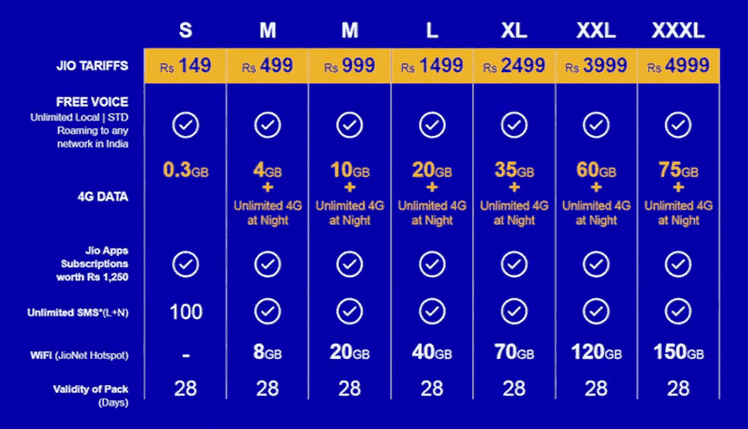
Tariff Plans of JIO
After looking ta the attached image, if we exclude the unlimited night data (and the wifi data which many of us may not have access to), then the price per GB of these plans is in range of INR60 to INR125 per 1GB. If you are someone who uses 5GB of data every month, and you were currently spending INR1000 per month with the current providers, you will be happy that you can get same amount of data for INR500. But, you are likely to spend the same amount of money over the time and consume 10GB of data for INR1000, instead. This is because 4G speeds are awesome and now there are many more ways to spend the data. And, since you have the budget for it, you are likely to spend more. So, even though you are getting much more value than the current operator, JIO will still make the same/better revenue, as compared to the existing competitors.
RIL angle:
If you do the math, you will be able to realize that even if 25%-30% of people in India will use 2GB of JIO internet data per month, then RIL will recover the entire initial investment $22B in just 3yrs.RIL/JIO has left no stone unturned for this mega project. According to Shri Mukesh Dhirubhai Ambani, currently India stands 150th in mobile Internet rankings out of 230 countries. He believes that India's rank will go up from 150 to among the top 10 of mobile Internet rankings in the world due to this project. We need huge companies like Reliance to invest in such mega projects for our entire country to progress.
Jio Route (Jio's full fiber network) on Google Maps:
google.com/maps/d/embed?mid=1dAcxwsLqgNaMiqkf4r6pXMQN_8o
Sources:
https://en.wikipedia.org/wiki/Telecommunications_statistics_in_India
https://en.wikipedia.org/wiki/Jio
http://www.trai.gov.in/sites/default/files/Press_Release_11_17_Feb_2017_Eng_0.pdf
telecom.economictimes.indiatimes.com/news/3g-4g/reliance-jios-voice-and-broadband-network-is-upgradable-to-5g-mukesh-ambani/47644803
http://www.livemint.com/Industry/tyb7WgA82kVA9vGM5DtHoJ/Reliance-Jio-to-raise-Rs15000-crore-via-rights-issue.html
http://www.airtel.in/leap
telecom.economictimes.indiatimes.com/news/undersea-8000-km-long-cable-project-by-reliance-jio-vodafone-others-reaches-chennai/50686502
http://www.dnaindia.com/money/report-rjio-logs-into-biggest-broadband-cable-system-2157904
http://telecomtalk.info/reliance-jio-takes-the-green-towers/143650/
https://www.youtube.com/watch?v=vgZoVtu8aag
http://trak.in/tags/business/2016/03/30/reliance-jio-data-price-voice-calling-sim-card/
http://telecomtalk.info/jio-fiber-to-the-home-deliver-speeds-up-to-1gbps/147416/
indianexpress.com/article/technology/tech-news-technology/with-rjio-4g-indias-mobile-internet-ranking-to-reach-top-10-globally-mukesh-ambani/
https://www.quora.com/How-likely-is-that-Reliance-Jio-4G-will-revolutionise-the-internet-market-in-India/answer/Kshitij-Salgunan
https://www.quora.com/What-is-the-business-model-of-Reliance-Jio/answer/Kshitij-Salgunan
https://www.google.com/maps/d/embed?mid=1dAcxwsLqgNaMiqkf4r6pXMQN_8o&hl=en_US
https://www.quora.com/How-likely-is-that-Reliance-Jio-4G-will-revolutionise-the-internet-market-in-India/answer/Kshitij-Salgunan
https://www.quora.com/What-is-the-business-model-of-Reliance-Jio/answer/Kshitij-Salgunan
https://www.google.com/maps/d/embed?mid=1dAcxwsLqgNaMiqkf4r6pXMQN_8o&hl=en_US
what on earth is 3D Printing
What is 3D Printing?
3D printing, also known as Additive Manufacturing, refers to processes used to synthesize a 3D (three-dimensional) object in which successive layers of material are formed under computer control to create an object. Objects can be of almost any shape or geometry and are produced using digital model data from a 3D model or another electronic data source such as an Additive Manufacturing File (AMF) file.
How does 3D Printing work?
It works just like any other inkjet printer - with the only difference that instead of Ink, it deposits the desired material in successive layers - thus creating a desired physical object.
What can be 3D printed?
Almost everything - Houses, Cars, Food, Dresses, Toys, Body parts/organs, Jewelry
Almost everything - Houses, Cars, Food, Dresses, Toys, Body parts/organs, Jewelry
What's the History of 3D printing?
In 1984, Chuck Hull of 3D Systems Corporation developed the 1st Stereolithography Apparatus. Stereolithography - also called Optical fabrication or Photo solidification or Resin printing - is a form of 3D printing technology used for creating models, prototypes, patterns, and production parts in a layer by layer fashion using Photopolymerization (a process by which light causes chains of molecules to link together, forming polymers). In 1986 Charles Hull was awarded a Patent for his SLA. In 1992, 1st SLA machine was developed by 3D Systems Corporation.
What is the history of Organ printing?
Organ printing is also called Bio printing, or Body part printing, or Computer-aided tissue engineering. It happened for the 1st time in 1999 when a 3D-printed synthetic bladder was produced. In 2002 a fully-functional 3D-printed synthetic kidney was produced. In 2008, a 3D-printed synthetic leg was produced and a person walked using it. In 2009, a 3D-printed synthetic blood vessel was produced by Organovo. In 2012, a 3D-printed synthetic jaw was produced.
Resent advances:
In 2008, Shapeways, launched a Print-on-Demand service.
In 2014, Amazon lunched its 3D printing marketplace.
In 2015, Google acquired Carbon3D
What can we expect 3D printing doing by 2030?
1. The price of the cheapest 3D printer has already come down from $18k to $400 within last 10 years.It will become far-more cheaper & it will thus become affordable - Each household will have a 3D-printer.
2. Houses will be built-on-demand - China already 3D-printed 10 houses in 1 Day.
3. 10%-20% of everything will be 3D-printed - Already many shoe-manufacturers have started making 3D-printed shoes. Spare airplane parts are already 3D printed in some airports. Some space stations have a 3D printer that eliminates the need for the large amount of spare parts they used to have in the past.
4. Smartphones will have 3D scanning feature - you will be able to 3D-scan your feet, and print your perfect shoe at home.
5. 3D printed jaws & skulls have been implanted successfully till now. 3D-printed Livers will be implanted soon.

What is the history of Organ printing?
Organ printing is also called Bio printing, or Body part printing, or Computer-aided tissue engineering. It happened for the 1st time in 1999 when a 3D-printed synthetic bladder was produced. In 2002 a fully-functional 3D-printed synthetic kidney was produced. In 2008, a 3D-printed synthetic leg was produced and a person walked using it. In 2009, a 3D-printed synthetic blood vessel was produced by Organovo. In 2012, a 3D-printed synthetic jaw was produced.
Resent advances:
In 2008, Shapeways, launched a Print-on-Demand service.
In 2014, Amazon lunched its 3D printing marketplace.
In 2015, Google acquired Carbon3D
What can we expect 3D printing doing by 2030?
1. The price of the cheapest 3D printer has already come down from $18k to $400 within last 10 years.It will become far-more cheaper & it will thus become affordable - Each household will have a 3D-printer.
2. Houses will be built-on-demand - China already 3D-printed 10 houses in 1 Day.
3. 10%-20% of everything will be 3D-printed - Already many shoe-manufacturers have started making 3D-printed shoes. Spare airplane parts are already 3D printed in some airports. Some space stations have a 3D printer that eliminates the need for the large amount of spare parts they used to have in the past.
4. Smartphones will have 3D scanning feature - you will be able to 3D-scan your feet, and print your perfect shoe at home.
5. 3D printed jaws & skulls have been implanted successfully till now. 3D-printed Livers will be implanted soon.
Important videos on this topic:
Sources:
http://www.engineering.com/Portals/0/BlogFiles/3D%20Printing/0913/hist3d.jpg
http://3dmasterminds.com/wp-content/uploads/2015/12/3d_Printing.jpg
https://en.wikipedia.org/wiki/3D_printing
https://s-media-cache-ak0.pinimg.com/originals/72/27/b9/7227b940febac728b7432c9cfd59fde1.jpg
http://explainingthefuture.com/3dprinting.html
https://s-media-cache-ak0.pinimg.com/originals/72/27/b9/7227b940febac728b7432c9cfd59fde1.jpg
http://explainingthefuture.com/3dprinting.html
what on earth is IoT aka Internet Of Things
Imagine a world where every object will be performing optimal & human-like actions. In the night, if you are standing alone at a bus-stop, the bulbs at the bus-stop will light up mildly, but as more people will join you, the bulbs will fully lighten up. While returning home, your refrigerator sends you a text on your phone reminding you of the sausage that you need to buy today. While at dinner, your plate will play mild music for you and will alert you if you try to eat more than normal. This and much more will possible with IoTs :)
The Internet of things (IoT); also called "connected devices" and "smart devices" by some; is the internetworking of physical devices, vehicles, buildings, appliances, and other items - embedded with electronics, software, sensors, actuators, network connectivity - that enable these objects to perform meaningful; business or personal; tasks for you.
In simple language:
When you convert any given Object into a Smart Object it is called IoT.
What do we mean by Smart Object?
Any given object that can - connect, monitor, manage, control, search - all without human intervention can be called Smart. And, we; humans; will have the ability to remotely control this object.
How do you turn an object into a smart object?
We can do that by giving that object a unique identity, the ability to communicate, applying sensors so it collect data from it's surroundings.
********** Examples **********

Soon every piece of an entire fleet of Virgin Atlantic's aircrafts will be made an IoT.
So, the parts of the plane will report mechanical problems before they would turn into failures.
This Smart Ring keeps you connected with who and what matter most.
Calls, texts, email and social networking in style.
Baby Smart Monitoring system sends you regular updates to your phone about your baby’s body position, breathing level, body temperature, response to activities, health, etc.

Amazon's Echo micro-listens to your voice in your home and does as instructed (like music playback, making to-do lists, setting alarms, streaming podcasts, playing audiobooks, and providing weather, traffic and other real time information).
*********************************************
The word IoT was coined by Kevin Ashton back in 1999.
Following are some good reads on IoT. Click these links to read them:
- Medium.com/Why-everyone-should-care-about-IoT
- An infograph explaining IoT
- What exactly is Internet of Things (IoT)?
- What is the 'Internet of Things'? Is there a course to learn it?
- A storyboard explaining IoT
- What is the scope and future of the Internet of Things?

Artificial Intelligence, Machine Learning, Natural Language Processing, Deep Learning, Data Science, Big Data, Recommendation Engine, Algorithms - Best questions & answers on Quora
- How is Deep Learning implemented in Amazon Go?
- How can you explain Deep neural networks or Deep Learning in layman's terms?
- How can I learn Deep Learning quickly?
- What's the most effective way to get started with Deep Learning?
- What are the open research areas in Deep Learning?
- What is the difference between AI (Artificial Intelligence), ML (Machine Learning), NLP (Natural Language Processing), DL (Deep Learning)?
- How are Big Data and IoT (Internet of Things) related?
- How exactly is Machine Learning used in Recommendation Engines?
- How can I start building a Recommendation Engine?
- What is the future of Recommender Systems research?
Some important questions of Algorithms on Quora:
Recent Inventions & Innovations (Innovative Products, Designs, Technologies) - Best questions & answers on Quora - Best questions/answers on Quora
- What are the best new products or inventions that most people don't know about?
- What are some of the simplest yet amazing innovations?
- What is that you wish would go away, but still exists?
- What did you invent as a kid, only to find it had already been invented?
- What's the most innovative app?
- What are some mind-blowing technologies that exist that most people don't know about?
Subscribe to:
Posts (Atom)